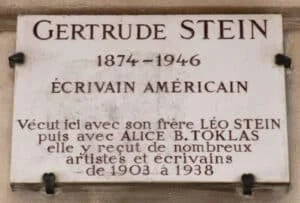
GERTRUDE CONQUERS AMERICA
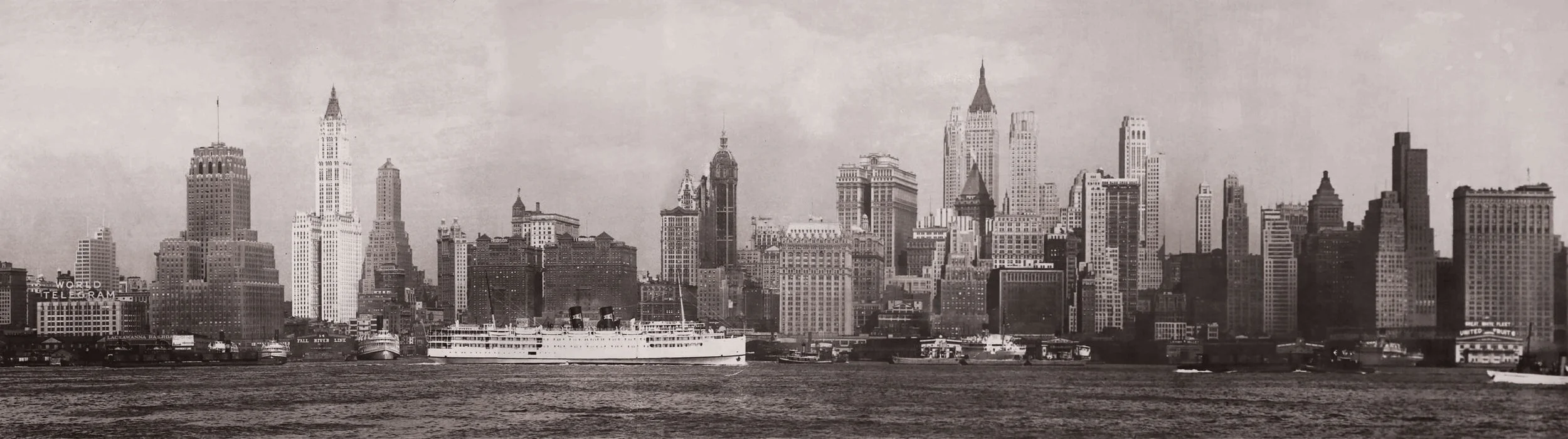
MANHATTAN — Oct. 24, 1934 — On a crisp autumn afternoon, the S.S. Champlain sails past the Statue of Liberty and docks along the Hudson. Hundreds disembark but the nation focusses on one passenger in particular, one passenger, one in particular. One.
Readers familiar with such repetition did not know what to expect from the returning writer. Would she talk as she wrote? Would she insult America, claiming “there is no there there?” What could one make of a woman who wore blocky shoes, a Robin Hood hat, and hair cropped like a man’s?
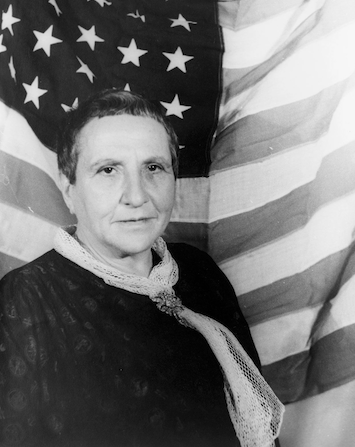
One reporter expected “a languid woman. . . smoking cigarettes, sipping absinthes perhaps and looking out upon the world with tired, disdainful eyes,” Instead, America became smitten with Gertrude Stein.
Hosting Picasso and Matisse and modernity itself in her Paris salon, Stein was America’s most notorious exile. Few tackled her prose, with its playful and ponderous repetition, yet all knew “a rose is a rose is a rose” and perhaps her comment to Hemingway — “you are all a lost generation.”
Now, as newspapers noted:
Gertrude Stein, Stein / Is Back, Back, and It’s / Still All Black, Black.
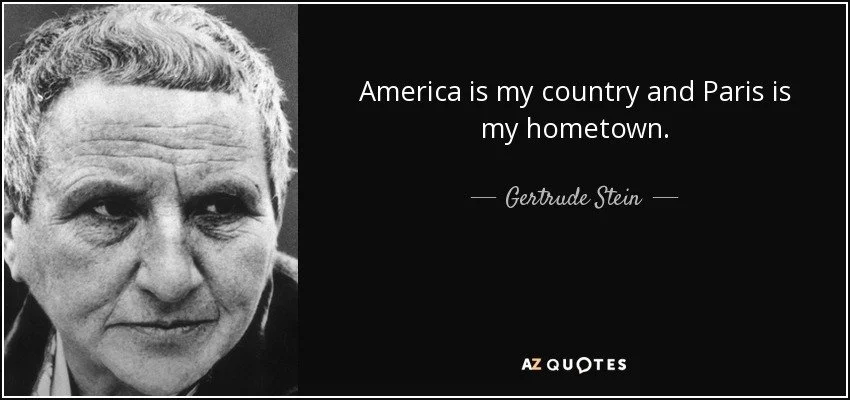
For the next six months, Stein and her companion Alice Toklas toured America. Thirty-seven cities in twenty-three states. “America is my country,” Stein had written, “and Paris is my hometown.”
Yet she had not been to her country since fleeing to Paris in 1903. “I used to say that I would not go to America until I was a real lion a real celebrity at that time of course I did not really think I was going to be one.”
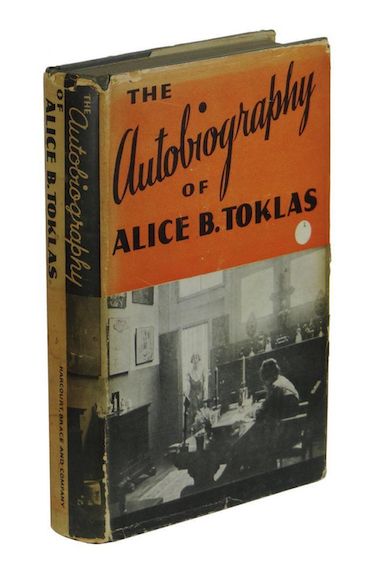
When The Autobiography of Alice B. Toklas, written in what Stein called her “audience voice,” became a bestseller, her publisher invited her on a book tour. The tour began on the dock in Manhattan where she faced a skeptical press. Before anyone could speak, Gertrude Stein held forth.
“Suppose no one asked a question,” she said. “What would the answer be?” Following inquiries about her voyage, etc., one reporter asked what was on everyone’s mind.
”Why don’t you write as you talk?”

Stein shot back. “Why don’t you read as I write?” Then she softened. “I do talk as I write, but you can hear better than you can see. You are accustomed to see with your eyes differently to the way you hear with your ears, and perhaps that is what makes it hard to read my works.”
But what about all that repetition?
“No, no, no, no, it is not all repetition. I always change the words a little.”
That evening, looking out from her Times Square hotel, Stein saw a headline scroll — “GERTRUDE STEIN HAS ARRIVED!” And overnight “the Sibyl of Montparnasse” was transformed, as one journalist noted, “from curiosity to celebrity.”
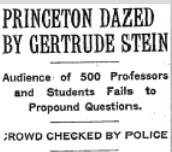
Recognized on the street, quoted everywhere, Stein charmed America. She was known as “a very difficult writer,” said Stanford Professor Wanda Corn. “So they were pleasantly surprised when she arrived and talked in sentences and was straightforward, witty and laughed a lot.”
Stein was equally smitten. Though her country was in the grips of Depression, Stein saw it with fresh eyes. “The wooden houses of America excited me as nothing else in America excited me.” She loved corn bread and honey dew melons, but mostly she loved the people.
“They come up to me and say, ‘Miss Stein?’ And I say, ‘Yes,’ and then we talk in the most friendly fashion, not at all as if they were seeking out some one who had attained some notoriety. I find it perfectly charming.”
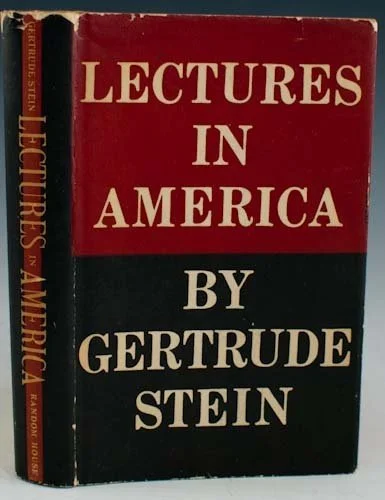
Professors, however, wanted more from “the high priestess of the Left Bank.” Stein agreed to lecture on modern lit — with a few ground rules. No introduction, she would just walk onstage. Audience limit: 500. She would read verbatim, then took questions.
What did she mean by ‘a rose is a rose. . .”
“Now listen!” she replied. “Can’t you see that when the language was new — as it was with Chaucer and Homer — the poet could use the name of a thing and the thing was really there? He could say ‘ O moon,’ O sea,’ ‘ O love’ and the moon and the sea and love were really there.”
Ummm, okay.
“And can’t you see that after hundreds of years had gone by and thousands of poems had been written, he could call on those words and find that they were just wornout literary words? . . . I’m no fool. I know that in daily life we don’t go around saying ‘ is a . . . is . . . is . . .’ Yes, I’m no fool; but I think that in that line the rose is red for the first time in English poetry for a hundred years.”
Always polite yet tiring of the same questions, Stein bristled when accused of being eccentric for a living. “Present day geniuses can no more help doing what they are doing than you can help not understanding it,” she said, “but if you think we do it for effect, and to make a sensation, you’re crazy.”
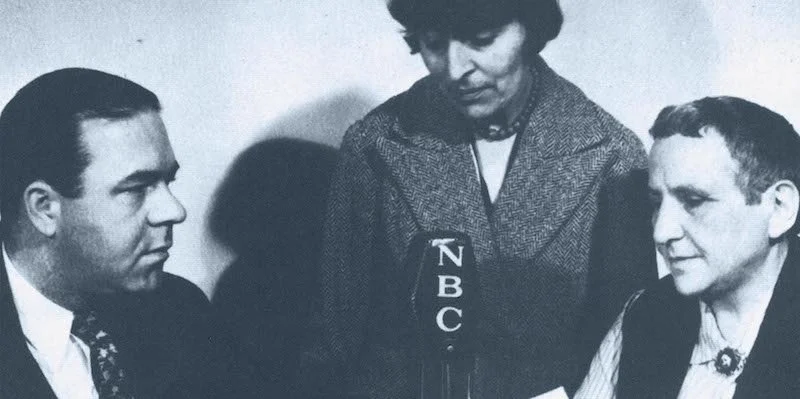
When not onstage, Stein remained in the news. Tea with Eleanor Roosevelt at the White House. Listening to Gershwin play songs from “Porgy and Bess.” Riding with Chicago cops in their squad car. Dining in Hollywood with Charlie Chaplin and in Baltimore with old friends Scott and Zelda.
But for Stein, the highlight was her first flights. Gazing down at the American landscape, she saw a cubist painting.
“I saw there on the earth the mingling lines of Picasso, coming and going, developing and destroying themselves. . . Once more I knew that a creator is a contemporary, he understands what is contemporary when the contemporaries do not know it yet.”
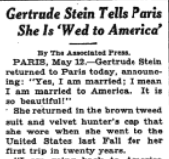
Stein made one final flight across America for a meeting with her publisher. Back in Paris, she wrote the trip into Everybody’s Autobiography. How had she liked America? Repetition again. “I did like being everywhere everywhere where I was I never very much wanted to be any other place than there.” But she saved her “audience voice” for writer Sherwood Anderson whom she had visited in New Orleans.
“It was beautiful that American country. It was it is there is nothing to be said about it but that that it was and it is beautiful.”