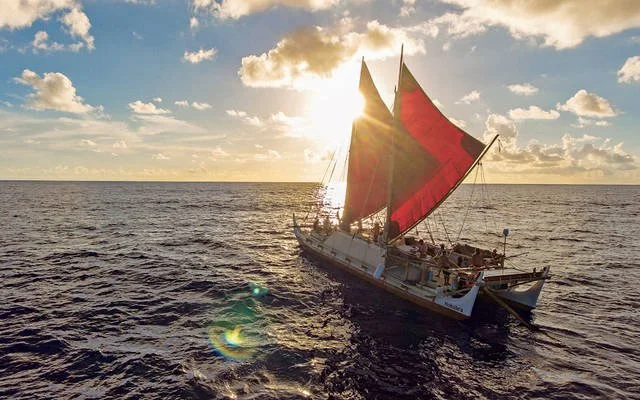
STAR OF JOY -- THE VOYAGES OF Hōkūle‘a
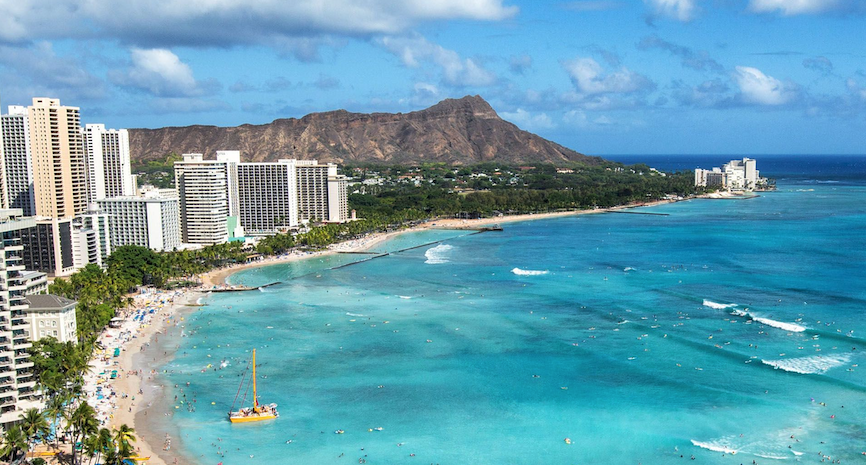
HONOLULU, MAY 1, 1976 — On another sparkling morning, a small catamaran with upside down sails floats beyond the breakers of Waikiki and heads out to sea. Hōkūle‘a, powered solely by wind, guided only by sea and stars, is on its way. Destination — 2,750 miles across the Pacific to the palm-lined shores of Tahiti.

On becoming America’s 50th state, Hawaii had lost much of its soul. Tourism trampled ancient ways. Traditions were packaged into stereotypes — grass huts and hula dancers, luaus and flowered leis. But Hōkūle‘a revived the old culture, sailing on, each mile refuting a myth.
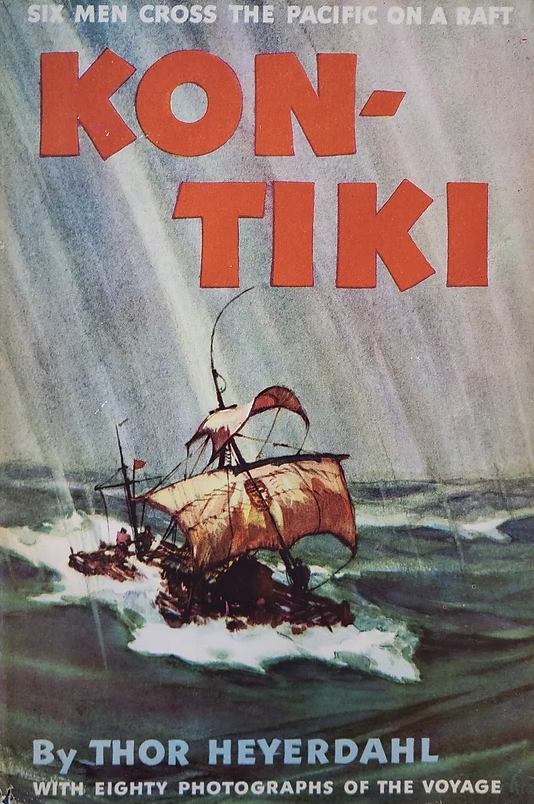
Since the 1950s, every school kid had learned of the Kon-Tiki. In 1947, Norwegian Thor Heyerdahl sailed his raft from South America to Polynesia, testing his theory — that the far-flung islands of the South Pacific were settled not by Asians but by South Americans.

But Ben Finney wondered if it was so simple. A Berkeley trained anthropologist, Finney came to Hawaii in the mid-fifties, before it became a state. Surfing had yet to come to the mainland, but Finney fell in love with riding the waves. He was writing his Master’s thesis on the history of Hawaiian surfing when a friend gave him a book by a New Zealand scholar.

Ancient Voyagers in the Pacific declared Polynesian canoes too flimsy and Polynesian navigation too primitive to master the Pacific. Finney was skeptical. In 1973, after earning a doctorate at Harvard, he returned to Hawaii where he co-founded the Polynesian Voyaging Society. The goal: to revive the ancient science of “way finding” and prove Thor Heyerdahl wrong.

Building a traditional Polynesian wa’a kaulua was the easy part. Double hulls lashed together. Sturdy masts. “Crabclaw” sails that looked like someone hoisted the mainsail upside down. Finney called it Hōkūle‘a, “Star of Joy.”
But who in Hawaii still knew the ancient skills of Polynesian navigation?
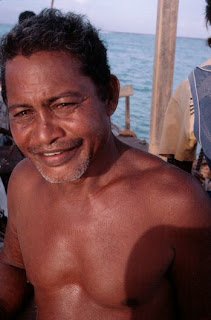
Polynesian navigation went back 4,000 years, but a man everyone in Honolulu called “Mau,” still cherished the old ways. Man grew up with the ocean. His father and grandfather taught him its secrets. As an infant in Micronesia, Mao was set down in tidepools to feel the rhythm and power of the waters. The sea taught him still more on solo voyages from island to island.
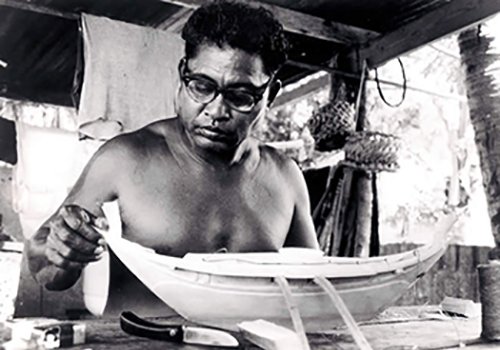
After befriending a Peace Corps volunteer in Micronesia, Mau came to Hawaii and soon met Ben Finney. Finney was impressed. Navigating from one island to the next was impressive, Finney said, but could Mau steer a 12-ton canoe, with no power, no instruments, no maps, from Honolulu to Tahiti?
Mau barely spoke English but the thrill of such a voyage spoke a universal language.
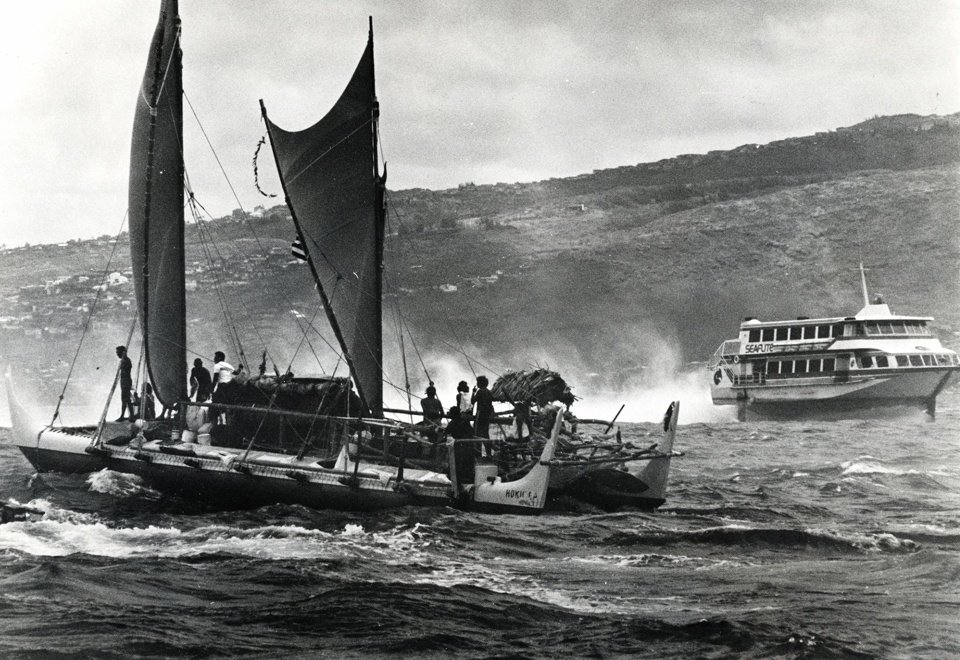
May 1976: With a crew of 17, a dog named Hoku, a pig, a rooster, and a hen, Hōkūle‘a heads due south from Honolulu. By day, Mau guides Hōkūle‘a, using clouds, birds, and ocean swells. By night, Mau charts latitude using (take a deep breath) Wuliwulifasmughet, aka the North Star. Below the equator, he turns to Luubw, the Southern Cross. Charted on Mau’s ancient star compass, the star Murn (Vega) and the constellation Wylur (the Big Dipper) offer their assistance.

On across the vast Pacific, the 62-foot “Star of Joy,” steered only by a long paddle, rides the winds. On Hōkūle‘a‘s 31st day at sea, Mau announced that they would soon spot land. Hours later, white terns flecked the horizon. That night they saw lights off towards Tupul, the “setting.” The following morning they landed in Papeete. Half the population, some 17,000 people, turned out to greet them.

Hōkūle‘a has since completed a dozen voyages. Mau’s student, Hawaiian-born Nainoa Thompson, has steered the craft to Japan, Canada, and the Pacific Coast where crowds admired its simplicity and its sagacity. In 2014, Thompson took Hōkūle‘a around the world — 47,000 nautical miles, 85 ports, 26 countries. With only birds, sea swells, and the stars to steer by.
Hōkūle‘a is currently on the waves again. Its five-year “Voyage for the Earth” will take the craft to 36 countries and 345 ports. This fall, Hōkūle‘a is in Aukland, New Zealand where it will stay for awhile to dodge typhoons from a strong El Niño. “Nature is telling us what to do,” Thompson said. “We go when nature allows us to go, when nature gives us permission to go. And I do think our ability to be sailing for 50 years was being disciplined to that.” Chart Hōkūle‘a’s voyage here.

Before his death in 2010, Mau Piailug received many honorary degrees. “The rebirth of non-instrument navigation,” the Smithsonian noted, “came about largely due to this man.” Along with Polynesian pride, he and Hōkūle‘a helped spark a “Hawaiian renaissance,” reverence and revival of the islands’ history, folklore, and culture.

“The voyage changed the whole identity of the Hawaiian people,” Nainoa Thompson said. “We went from being castaways to being children of the world’s greatest navigators.”
Flowered leis and hula dancers still greet tourists in Hawaii. But those curious about more than kitsch can take pride in the voyages of a little craft that set sail to challenge a theory and came home a hero. As a Hawaiian proverb has it: “Everybody paddles the canoes together; bail and paddle, paddle and bail, and the shore will be reached.”